


|
|
|
► Classificações |
|
Órbita
Orbitopatia tiroideia auto-imune
Outras classificações usadas na OT:
1) CAS (Clinical
Assessment
Score)

As disease activity rather than duration of disease is the prime determinant of the outcome of treatment, a clinical assessment score has been developed.
The presence of each of the following scores one of a possible 10.
| Pain | Painful, oppressive feeling on or behind eye over past 4 weeks |
| Pain on attempted eye movement over past 4 weeks | |
| Redness | Eyelid(s) red |
| Diffuse conjunctival injection covering at least one quadrant of eyeball | |
| Swelling | Swollen eyelid(s) |
| Swollen caruncle | |
| Proptosis increasing >2mm over last 1-3 months | |
| Chemosis | |
| Loss of Function | Reduced eye movements (>5° in any direction over 1-3 months) |
|
Reduced visual acuity (eg 1 line on Snellen chart over 1-3 months |
2) NOSPECS
A committee of the American Thyroid Association made the following recommendation to grade severity with the acronym
NOSPECS.
| Class 0 | No signs or symptoms |
| Class 1 | Only signs (eg lid retraction ±lid lag) |
| Class 2 | Soft tissue involvement (conjunctival oedema, injection etc) |
| Class 3 | Proptosis |
| Class 4 | Extraocular muscle involvement (ie diplopia) |
| Class 5 | Corneal involvement (primarily due to lid lag) |
| Class 6 | Sight loss (optic nerve involvement). |
3) Mourits score 3
An indication of activity is provided by the Mourits score 3.
This gives a value to each of the following signs and symptoms:
orbital pain or pain during ocular movement,
redness (eyelid or conjunctiva),
swelling (proptosis, lid oedema, chemosis or caruncle oedema),
limitation of ocular movements,
and visual dysfunction (acuity, field and colour).
Of a total of 10 scores, patients with a score of 3 and higher and/or an increasing score on follow-up are judged to be active.
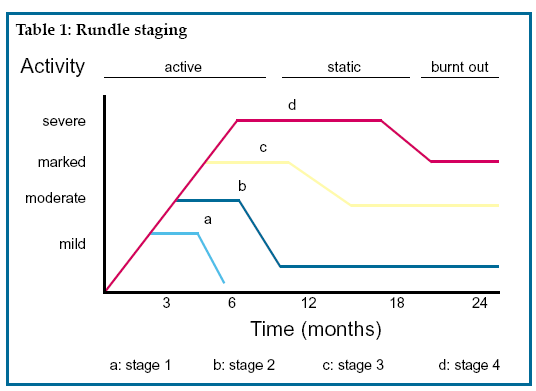
4) Rundle
The Rundle staging record the severity of the ocular involvement.
| Grade 1 (mild) | ophthalmopathy can present with ocular discomfort, transient oedema and mild proptosis (Rundle a). The duration is typically two to four months and it normally resolves with no sequelae. |
| Grade 2 (moderate) | ophthalmopathy includes eyelid retraction, conjunctival oedema, ocular ache and moderate proptosis (Rundle b). |
| Grade 3 (marked) | ophthalmopathy presents with ocular motility disturbance with diplopia, chemosis and marked proptosis (Rundle c). This develops over six to twelve months and often leads to persistent diplopia and proptosis. |
| Grade 4 (severe) | ophthalmopathy presents with optic nerve dysfunction with reduction of colour vision and visual acuity loss (Rundle d). After 12 to 24 months patients may be left with optic nerve damage, double vision, lid retraction and proptosis. (Table 1). This is a serious eye condition with a considerable threat to vision. |
|
|
|
► Classificações |
|